
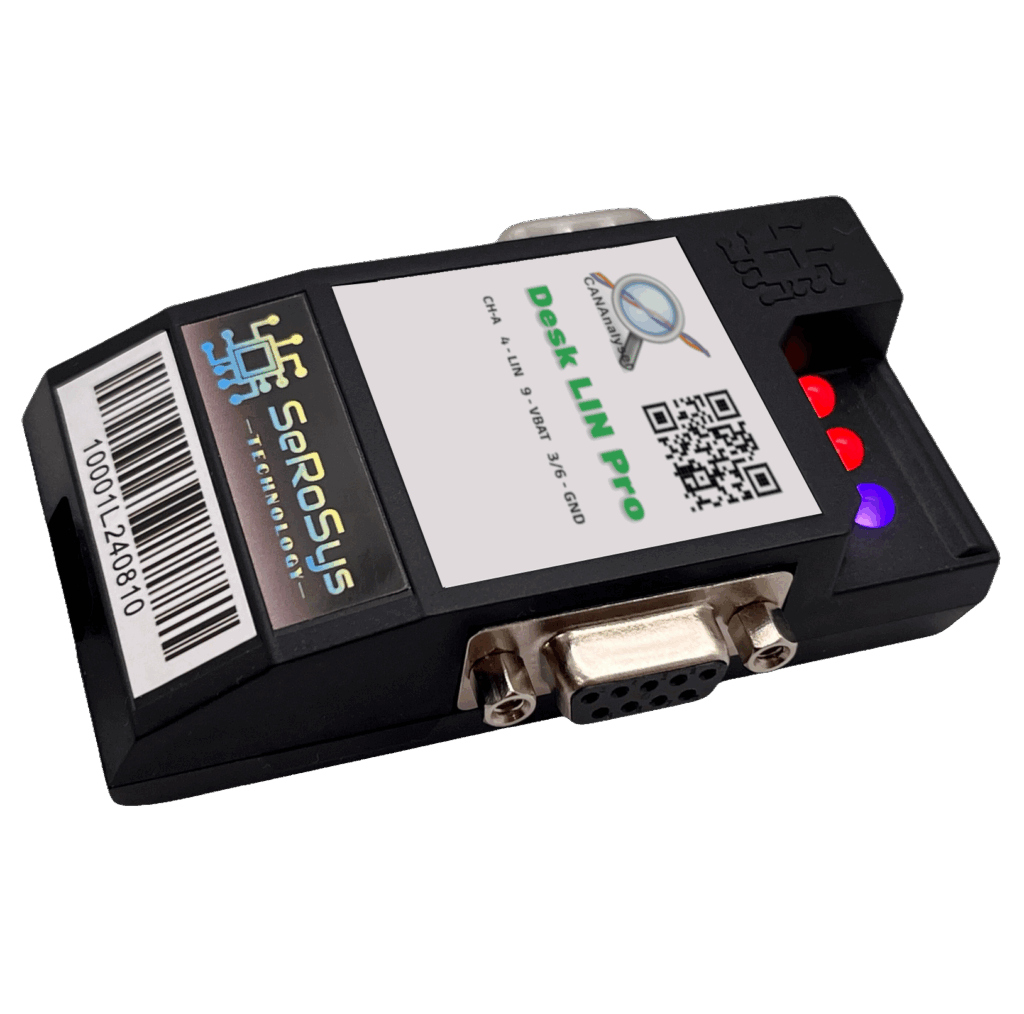
LIN ANALYSIS & LOGGING – COMING SOON AT SEROSYS-TECHNOLOGY
At SeRoSys-Technology, we are expanding our well-known CAN analysis portfolio:
LIN analysis and logging support will soon be available with our new Desk LIN Pro dongle.
This extension allows developers, testers, and integrators to analyze, simulate, and debug LIN networks with the same reliability and precision they already know from our CAN tools.
WHAT IS LIN AND WHY DO WE SUPPORT IT?
LIN (Local Interconnect Network) is a low-cost serial communication protocol widely used in automotive and industrial systems. It complements higher-level bus systems such as CAN by connecting simple sensors and actuators in a cost-efficient and deterministic way.
At SeRoSys-Technology, we specialize in bus analysis, diagnostics, and logging. As modern systems increasingly combine multiple bus technologies, supporting LIN is a natural and necessary extension of our portfolio.
WHERE IS LIN USED?
LIN is widely used in automotive body and comfort electronics, where cost efficiency and reliable communication are key requirements. Typical applications include door modules and window lifters, seat control and climate systems, as well as mirror adjustment and interior lighting. In addition, LIN is commonly used to connect simple sensors and actuators to a central control unit.
Thanks to its simplicity and robustness, LIN is ideally suited for distributed control systems with moderate real-time requirements.
HOW LIN WORKS
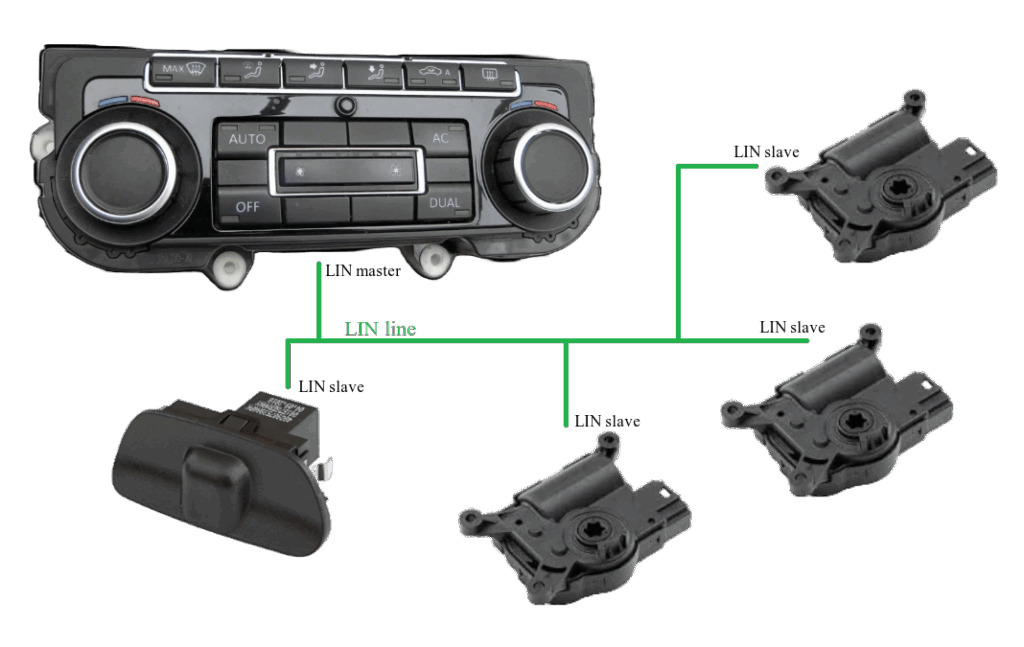
LIN is a single-master, multiple-slave communication system in which all bus activity is initiated by the master node. The master sends a header consisting of a break field, a synchronization field, and an identifier that defines the timing and the addressed slave. The selected slave then responds with the corresponding data frame.
Communication follows a predefined schedule table, which ensures deterministic behavior and predictable timing. LIN frames can use either classic or enhanced checksums, depending on the application and LIN version. This simple yet robust mechanism allows reliable communication with minimal hardware and software overhead.
INTEGRATION IN SLSS CANANALYSER
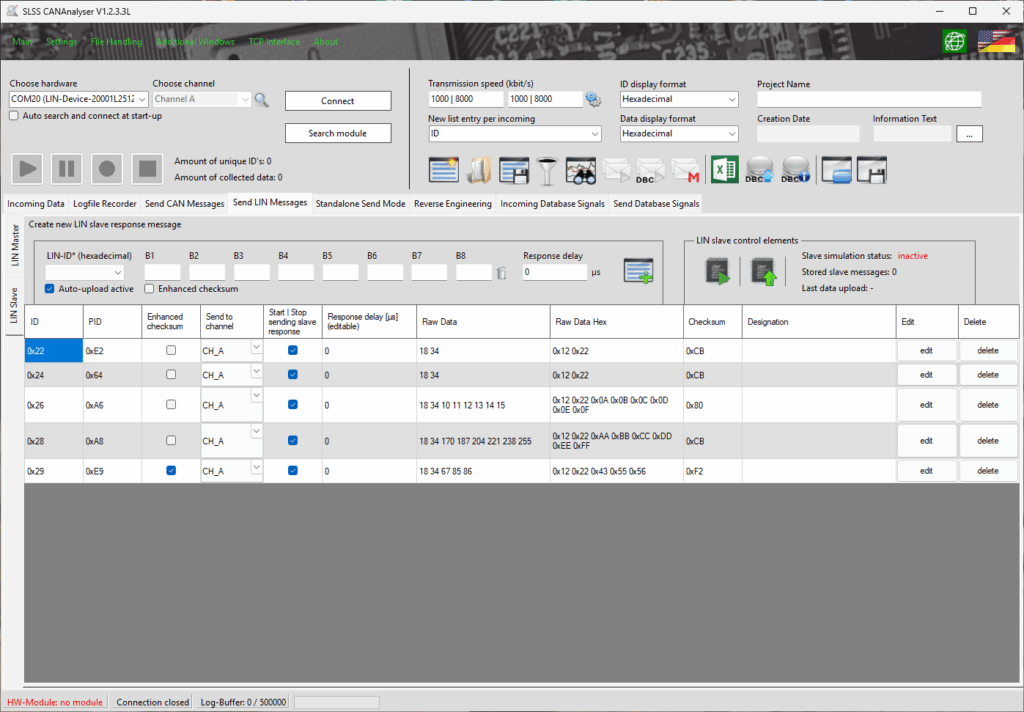
Our LIN support is seamlessly integrated into the existing analysis environment and follows the same intuitive workflow already familiar from CAN analysis. Incoming LIN frames can be received, filtered by identifier, and logged in real time, providing a clear and structured view of bus activity comparable to the CAN trace window.
Sending LIN master messages is just as straightforward as in the well-known CAN transmit section, allowing users to define and trigger LIN frames with minimal effort.
Switching between classic and enhanced checksum modes can be done easily, enabling quick adaptation to different LIN configurations and node requirements. Transmit lists can be defined, saved, and loaded, making it simple to reuse test setups and automate recurring communication patterns.
In addition to master functionality, the system supports hardware-based LIN slave simulation with memory for up to 64 messages. For each response, an individual response delay can be configured, allowing realistic timing behavior and precise simulation of real LIN nodes. This enables advanced testing scenarios such as ECU integration, robustness testing, and fault analysis.
Support for loading LIN Description Files (LDF) will be added soon, allowing LIN signals and data fields to be displayed in a human-readable form. This upcoming feature will further enhance analysis, diagnostics, and debugging by bridging the gap between raw frame data and meaningful signal-level information.

Discover how SeRoSys can elevate your operations with the most advanced LIN bus tools. Our team is here to answer any questions and provide all the details you need.
Feel free to contact ourSeRoSys Technology Marketing and Sales Team
sales@serosys-tech.com